
If you’ve ever tried to make ambient music with just the stock instruments and effects in your DAW, you’ve probably noticed pretty quickly that something feels missing.
The presets are too clean, the reverbs are too predictable, and the synth pads sound like they belong in a pop ballad rather than a Brian Eno record. Ambient music lives and dies on texture, movement, and the kind of organic imperfection that generic tools just don’t deliver. The good news is that the plugin world has gotten incredibly good at this stuff in recent years.
From granular synths that can turn a field recording into an evolving cinematic soundscape, to reverbs that transform a single note into an entire atmosphere, the tools available today make it possible to create genuinely immersive ambient music without spending thousands on hardware synthesizers and effects racks.
This list covers seven plugins that approach ambient music from different angles. We’ve got dedicated pad and drone synthesizers, a couple of reverbs specifically chosen for how well they create ambience, and a free exciter that adds life to sounds that feel flat and lifeless.
Whether you’re building drones from scratch, designing evolving textures, or just trying to make your existing sounds feel more spacious and alive, there’s something here for you.
1. Dawesome Novum by Tracktion (Granular Synth/Sampler)

Novum is one of those rare instruments that genuinely does something different from everything else on the market. Most granular synths let you load a sample and mess with the grain parameters until you get something interesting.
Novum takes that idea much further by pulling sounds apart into their individual timbral components before the granular processing even begins, using an approach to sample analysis that feels closer to audio forensics than traditional sound design.
The practical result for ambient producers is that you can take a single sample, anything from a piano chord to a field recording of rain, and extract an almost endless variety of textures from it without ever running out of creative possibilities.
Sci fi soundtrack composers, ambient producers, and anyone who makes music where atmosphere matters more than beats will find this thing absolutely mesmerizing to work with.
- Six Layer Spectral Decomposition Engine
At the heart of Novum is its unique decomposition algorithm that breaks any sample into six independent layers, each representing a different sonic aspect of the source material.
One layer might contain the fundamental tone, another the textural elements, a third the transient information, and so on. Each layer gets its own waveform display, granular controls, timbre settings, and envelope, meaning you can process, mute, solo, or completely reshape any aspect of the original sound independently of the others.
What makes this approach so powerful for ambient work is that you can mute the transient layers and keep only the body and texture, instantly turning a percussive sound into a smooth, evolving pad.
Or you can combine layers from completely different samples by dragging and dropping timbres between them, creating cross synthesis results that would be extremely difficult to achieve any other way.
- Timbre Flower and Homogenize for Texture Shaping
The Timbre Flower is Novum’s tool for spectrally modifying the tone colors of individual layers. It presents variations on the original timbre in a visual flower pattern, letting you explore adjacent tonal possibilities by moving between the petals.
The results range from subtle shifts in harmonic content to dramatic timbral transformations that make the original sample unrecognizable.
The Homogenize feature is specifically designed to create the kind of smooth, velvet like textures that are notoriously difficult with traditional granular synthesis.
Standard granular processing often produces a characteristically diffuse, glittery quality that can become fatiguing. Homogenize links all six layers and applies processing that produces seamless, continuous textures without the typical granular artifacts. For ambient pad creation, this single feature alone justifies the price of admission.
- Syntify for Hybrid Synth Drone Creation
The Syntify function comes in two flavors and converts your sample based sound into a hybrid synthesizer tone, as if the granular output were being passed through an analog synth circuit. The results are gritty, raw, and full of character, perfect for creating dark synth drones from organic source material.
Combined with the analog modeled filter and comb filter for adding pitched resonance, Syntify turns Novum into something much more versatile than a straightforward granular instrument.
- Effects Chain and Modulation System
Novum includes a six slot effects chain featuring reverb cloud, shimmer, delay, chorus, and phaser, all tuned for the kind of atmospheric processing that ambient producers need. Stacking multiple effects creates lush, deeply processed textures from a single instance.
The modulation system uses color coded sources that can function as either envelopes or LFOs, with freely drawable curves for non linear movement.
Full MPE support opens up expressive performance possibilities, and the instrument is highly optimized for CPU efficiency despite the complexity of its processing. Over 300 factory patches and multiple expansion packs focused specifically on ambient, cinematic, and experimental sound design are available. Novum runs as VST3 and AU on macOS and Windows.
2. Native Instruments Absynth 6 (Semi Modular Synth)

Absynth has been around since the early 2000s and honestly, nothing else in the Native Instruments catalog sounds quite like it. While other NI synths like Massive and Massive X are built for modern electronic music production, Absynth was always the weird one in the family.
It’s the synth you reach for when you need something that sounds alien, unsettling, beautiful, or all three at once.
What keeps Native Instruments Absynth 6 relevant after all these years is its semi modular architecture that lets you combine oscillators, filters, modulators, and effects in ways that most other synths simply don’t allow. The routing flexibility means you can build patches from scratch that produce evolving drones, atmospheric textures, and otherworldly pads that sound genuinely unique rather than like presets you’ve heard a thousand times before.
- Three Oscillator Channels with Flexible Routing
Absynth’s architecture centers on three independent oscillator channels (A, B, and C), each capable of running in multiple synthesis modes including subtractive, FM, ring modulation, and granular. What makes this interesting for ambient work is that you can run one channel in granular mode for texture, another in FM for metallic harmonics, and a third in subtractive for a smooth foundation, then blend all three together into a single layered patch.
Each channel has its own filter, modulator, and waveshaping options, and the routing between channels is flexible enough to feed one oscillator’s output into another’s input for complex signal flow configurations. This kind of deep routing is what allows Absynth to produce the dense, evolving textures that simpler synths can’t achieve.
- Envelope and LFO System with Breakpoint Editing
The modulation system uses freely drawable envelopes with an unlimited number of breakpoints, meaning you can create modulation shapes of any complexity and length. For ambient music, this is invaluable because you can design envelopes that evolve over 30, 60, or even 120 seconds, producing slow, gradual shifts in timbre, filter cutoff, or pitch that keep a pad interesting over long periods without any manual automation.
The LFOs can also be drawn freely and support looping at various points within the shape. Combining multiple complex envelopes and LFOs across different parameters is how experienced Absynth users create those patches that seem to live and breathe on their own.
- Cloud Filter and Granular Capabilities
The Cloud filter is one of Absynth’s most distinctive features, applying a granular processing stage within the filter section itself. This means you can take a straightforward subtractive oscillator patch and granularize it at the filter stage, breaking it into particles that shimmer and scatter across the stereo field. The cloud filter alone can turn a simple waveform into an ambient texture.
- Built In Effects Engine
Absynth includes a comprehensive effects section with reverb, delay, chorus, phaser, resonators, and pipe effects that can be configured per channel or globally.
The pipe effect in particular is unique to Absynth and models the resonance characteristics of physical tubes, producing droning, harmonically rich tones that are perfect for ambient sound design. The effects quality is high enough that many users leave Absynth as the only plugin on their ambient tracks.
Available through Native Instruments as part of Komplete or standalone, in VST, AU, and AAX formats.
3. ModeAudio Airspace (Reverb for Ambience)
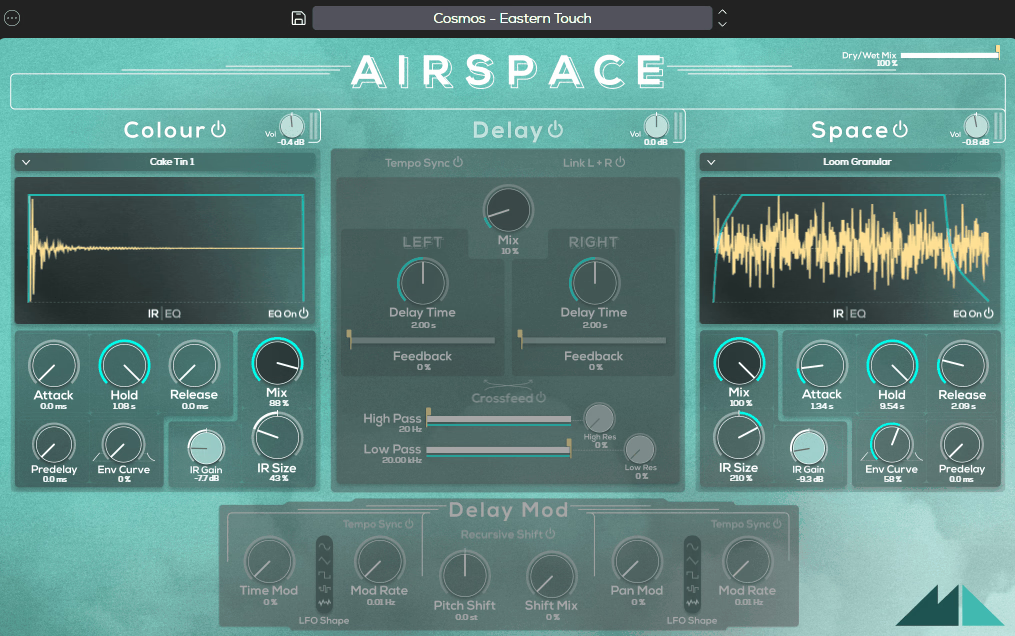
ModeAudio spent over a decade building a reputation for creating some of the most atmospheric, beautifully crafted sample packs in the ambient and electronic music world. Airspace is their first plugin, and it makes perfect sense that they built a reverb, because creating rich sonic spaces is literally what they’ve been doing this whole time, just with a different set of tools.
What makes Airspace particularly relevant for ambient producers isn’t just that it’s a good reverb. It’s that the entire design philosophy is oriented around turning ordinary sounds into extraordinary textures. ModeAudio poured over a decade of sound design expertise into this thing, and it shows in every aspect of the plugin from the quality of the included source material to how the processing stages interact with each other.
- Dual Convolution Engine with 450+ Impulse Responses
Airspace runs two separate convolution reverb modules in series with a stereo delay sandwiched between them. The first module, called Colour, is designed to impart timbral character to your signal using short, experimental impulse responses captured from things like guitar amplifiers, drum machines, piano strings, household objects, and found percussion. The second module, called Space, applies spatial reverb using longer IRs captured from real world environments including cathedrals, concert halls, nuclear reactors, submarines, and theatrical stages.
The total library includes over 450 meticulously recorded impulse responses organized into 11 categories. What makes this library special for ambient work is the experimental IRs, which produce results closer to granular processing than traditional reverb. Running a simple synth pad through a “Kitchen Cracker Packet” impulse followed by a “Grade I Listed Cathedral” impulse produces sounds that would take multiple plugins and considerable tweaking to achieve otherwise.
- IR Size Scaling from 20% to 500%
Each convolution module lets you scale the perceived size of the impulse response from 20% to 500% of its original length. At lower percentages, long reverb tails become tight, colorful bursts. At higher percentages, short impulse responses stretch into vast, otherworldly spaces. This single control dramatically expands the usability of every IR in the library.
Full AHR (Attack, Hold, Release) envelope controls shape how the impulse response develops over time. Combined with pre delay settings and dual 4 band EQs per convolution module, you have extensive control over the character of each reverb stage.
- Modulated Stereo Delay with Pitch Shifting
The delay section between the two convolution modules features independent left and right delay times with crossfeed, high and low pass filtering, and resonance. A dedicated modulation section includes a 4 octave pitch shifter and dual LFOs for modulating delay time and panorama, with five switchable shapes (sine, triangle, square, random, and smooth random).
For ambient music, the pitch shifted delay feeding into the second convolution stage creates shimmering, harmonically complex textures that evolve and self generate. Set the feedback high enough and Airspace becomes a texture generator that sustains and transforms indefinitely. Over 240 presets organized into Ambient, Blur, Cosmos, Reflect, Transform, and Warp categories are included. Available in VST3 and AU for macOS and Windows.
4. Slate Digital Fresh Air (Free Exciter)
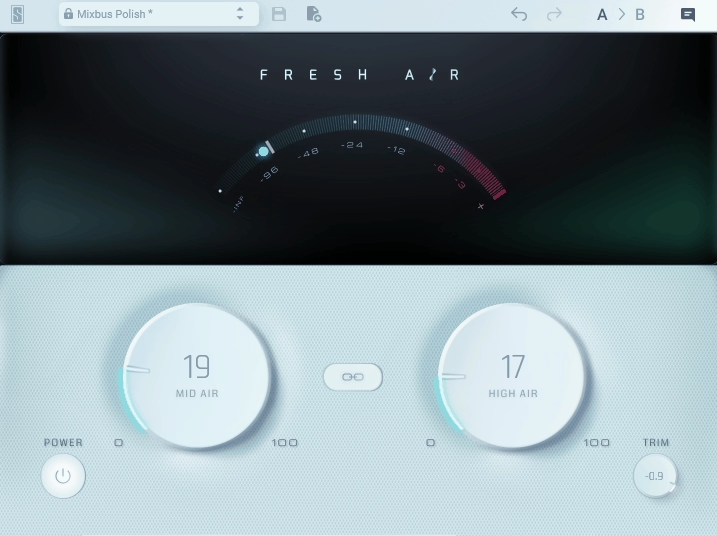
This one is a bit different from everything else on the list because it’s not a synth and it’s not a reverb. Fresh Air is a free exciter plugin from Slate Digital, and the reason it’s here is that it solves one of the most common problems ambient producers face: sounds that feel dull, lifeless, and buried even after careful mixing.
Ambient music often involves heavily processed signals that have passed through multiple layers of reverb, delay, and modulation. All that processing tends to eat up the high frequency detail and air that makes sounds feel present and alive. Fresh Air adds that back in with a dead simple interface that just works without requiring you to understand anything about harmonic excitation or psychoacoustics.
- Two Band Air Enhancement
Fresh Air operates with just two controls: one for the mid high frequency range and one for the high/air frequencies. The mid high band adds presence and clarity to the upper midrange, while the air band adds sparkle and openness to the very top of the spectrum. Both controls range from subtle enhancement to more aggressive brightening.
What’s notable is how musical the processing sounds compared to a standard high shelf EQ boost. Fresh Air uses harmonic generation rather than simple level increase, which means it’s creating new high frequency content rather than just turning up what’s already there. On heavily processed ambient material where the highs have been smeared by reverb and delay, this distinction matters enormously.
- Zero Cost with Professional Quality
The plugin is completely free with no restrictions, no trial period, and no locked features. Just download it from Slate Digital’s website, install it, and it works. The processing quality is consistent with Slate’s paid plugins, and there’s genuinely no catch beyond signing up for their newsletter.
For ambient producers on a budget, putting Fresh Air at the end of your processing chain can add significant life and dimension to tracks that feel flat. It works particularly well after heavy reverb processing where the original brightness of the source has been washed away.
- Lightweight and Universal Compatibility
Fresh Air uses minimal CPU resources and introduces zero latency, making it practical to place on every track in a session without any performance concerns. The plugin works in VST, VST3, AU, and AAX formats for Windows and macOS, and its simple two knob interface means there’s essentially no learning curve. Load it, adjust the two bands to taste, and move on.
5. Dawesome Love 2 by Tracktion (Granular Synth)

If Novum felt too complex for your needs, Love 2 is the other Dawesome granular synth worth knowing about, and it takes a deliberately simpler approach to the same basic concept. Where Novum decomposes samples into six layers with spectral analysis and offers deep editing on every parameter, Love 2 focuses on getting you to beautiful granular textures quickly without requiring a deep understanding of granular synthesis.
The design philosophy here is accessibility first. Love 2 is built around the idea that you should be able to load a sample, twist a few knobs, and immediately hear something inspiring. For ambient producers who want granular textures without the learning curve, or who just want a quick inspiration tool alongside more complex instruments, Love 2 fills that role nicely.
- Streamlined Granular Engine with Intuitive Controls
Love 2 strips granular synthesis down to its most essential and musically useful parameters. The grain controls cover size, density, position, and scatter, all presented in a clean interface that makes it immediately clear what each parameter does. You can hear the effect of every adjustment in real time, which makes sound design feel more like playing an instrument than programming a computer.
Sample import is drag and drop simple, and the synth includes a library of curated source material designed specifically for granular processing. The engine handles pitch tracking and tempo syncing automatically, so imported samples stay in tune and in time without manual adjustment.
- Built In Effects for Instant Atmosphere
Love 2 includes a focused effects section with reverb, delay, and filtering designed to turn raw granular output into finished ambient textures without external processing. The effects are voiced to complement the granular engine specifically, meaning the reverb tail enhances the granular shimmer rather than washing it out, and the delay adds rhythmic interest without cluttering the texture.
- Performance Controls and MPE Support
MPE (MIDI Polyphonic Expression) support lets you use controllers like the Roli Seaboard or Linnstrument to apply per note expression to your granular patches, adding vibrato, pressure based timbral shifts, and slide between notes. For ambient performance and recording, this kind of expression transforms static granular pads into living, responsive instruments.
Available from Tracktion in VST3 and AU formats for macOS and Windows.
6. Newfangled Audio Generate (Generative Synth great for pads and atmos)

Generate takes a fundamentally different approach to creating pads and drones than anything else on this list. Instead of starting with samples or traditional oscillators, it uses chaos theory and mathematical feedback systems to produce sound. The oscillators in Generate are based on equations that describe naturally occurring chaotic behavior, which means the raw waveforms themselves already contain the kind of organic movement and unpredictability that other synths need complex modulation to achieve.
The workflow with Generate feels different from any other synth I’ve used. Rather than starting from a blank canvas and building up, you’re more likely to start from something the synth proposes and sculpt it down to what you want. It’s a genuinely different way to work, and for ambient production where happy accidents are often more valuable than precise intentions, that approach is a perfect match.
- Five Chaotic Oscillator Types
Generate provides five oscillator models based on different chaotic systems: Double Pendulum, Vortex, Pulsar, Discharge, and String. Each model produces inherently complex, evolving waveforms that move and shift organically without any modulation applied. The Double Pendulum model, for instance, generates waveforms based on the physics of a double pendulum, which is a system famous for its sensitivity to initial conditions, meaning tiny parameter changes produce dramatically different sonic results.
For ambient and drone production, these chaotic oscillators are uniquely suited because the sounds they produce already breathe and evolve on their own. You don’t need to layer multiple LFOs and envelope modulations to prevent a pad from sounding static. The chaos is built into the fundamental waveform generation.
- Instant Pad Randomizer
The Randomize function generates completely new patches across all parameters simultaneously, producing usable results surprisingly often. Unlike randomizers in traditional synths that tend to produce harsh noise or silence, Generate’s chaotic architecture means that most random configurations produce some kind of interesting, textured sound. You can lock specific parameters to exclude them from randomization, so if you’ve found oscillator settings you like, you can randomize only the filter and effects to explore variations.
This workflow is perfect for ambient sessions where you want to quickly generate inspiration. Load Generate, hit randomize ten times, save the three patches you like, and you’ve got unique pad material in minutes.
- Harmonic Wavefolder and Resonant Filter
A wavefolder adds harmonic complexity by folding the chaotic waveforms back on themselves, creating additional overtones and timbral density. The resonant filter shapes the output with standard low pass, high pass, band pass, and notch modes, plus a dedicated feedback path that can push the filter into self oscillation for droning resonant tones.
- Built In Effects and Modulation
Generate includes delay, reverb, chorus, and distortion effects, plus a modulation matrix that can route internal chaos generators to any parameter. The modulation sources include the chaotic oscillators themselves, meaning the sound can modulate its own parameters in feedback loops that create endlessly evolving textures.
Available from Eventide (Newfangled Audio is now under the Eventide umbrella) in VST, VST3, AU, and AAX formats for Windows and macOS.
7. FabFilter Pro-R 2 (Reverb)
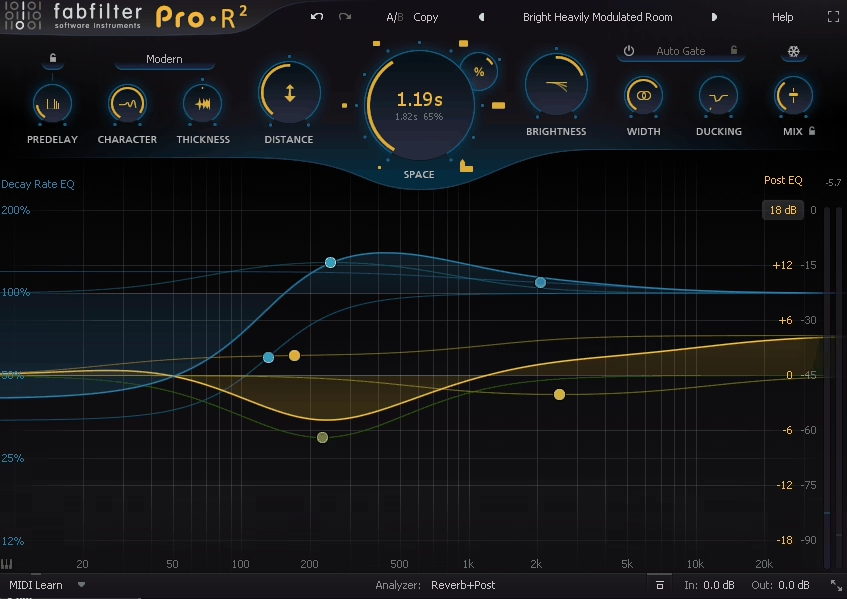
Including Pro-R 2 alongside a more specialized tool like Airspace might seem redundant, but these two reverbs do very different things. Where Airspace excels at experimental texture creation through convolution, Pro-R 2 is an algorithmic reverb that produces natural, infinitely adjustable spaces with the pristine sound quality and intuitive interface that FabFilter is known for. For ambient music, you often need both approaches.
The reason Pro R 2 earns its place here specifically is the overall smoothness of its algorithm at extreme settings. A lot of algorithmic reverbs introduce metallic artifacts or grainy textures at longer decay times, which becomes a real problem when you’re creating ambient music where the reverb tail is essentially the main attraction. Pro R 2 stays clean and musical even when you push the decay to absurd lengths, which is exactly what ambient producers need from their primary reverb.
- Decay Rate EQ for Frequency Dependent Reverb Shaping
Pro R 2’s most distinctive feature for ambient work is the Decay Rate EQ, which lets you set different reverb decay times for different frequency bands using the same drag and drop interface FabFilter popularized in Pro Q. You can have the low frequencies sustain for 15 seconds while the highs decay in 3 seconds, or create a dark, warm reverb where only a shimmer of high end persists, or any other combination you can imagine.
This frequency dependent decay control is what transforms Pro R 2 from a standard reverb into an ambient sound design tool. By sculpting how the reverb tail evolves across the frequency spectrum, you create spaces that have natural tonal movement built into their decay, producing far more interesting and organic results than a uniform decay time across all frequencies.
- Infinite Decay Mode for Drone Creation
Setting the decay time to infinity turns Pro R 2 into a freeze/sustain tool that captures and sustains whatever audio is passing through it indefinitely. Feed a single chord into an infinite decay and it will ring forever, slowly accumulating harmonics and creating a dense, evolving drone from a momentary input. This technique alone is responsible for countless ambient tracks.
The infinite mode combined with the Decay Rate EQ means you can freeze a sound while gradually filtering out specific frequency ranges over time, creating drones that evolve from bright and shimmering to dark and murky (or vice versa) with simple automation of the decay EQ bands.
- Space Control and Post EQ
The Space control adjusts the perceived distance and size of the reverb from intimate and close to vast and cavernous. The Brightness and Character controls shape the overall tone and diffusion of the algorithm. A 6 band post EQ with the full FabFilter filter set allows precise shaping of the reverb output after processing, which is useful for fitting the reverb tail into a mix or removing unwanted resonances.
- Dolby Atmos Support and Modulation
Pro R 2 supports immersive audio formats up to Dolby Atmos 7.1.4, making it suitable for spatial ambient productions. Built in modulation can animate reverb parameters for added movement, and the full suite of FabFilter workflow features including interactive displays, MIDI learn, and smart parameter interpolation make it as pleasurable to use as every other plugin in their lineup.
Available in VST, VST3, AU, AAX, and CLAP formats for Windows and macOS.

Hello, I’m Viliam, I started this audio plugin focused blog to keep you updated on the latest trends, news and everything plugin related. I’ll put the most emphasis on the topics covering best VST, AU and AAX plugins. If you find some great plugin suggestions for us to include on our site, feel free to let me know, so I can take a look!