
Exciters have been a studio secret weapon since the mid 1970s, when the original Aphex Aural Exciter started showing up on records by Fleetwood Mac, Jackson Browne, and Linda Ronstadt. The basic idea is simple: generate harmonics that weren’t in the original signal to make things sound brighter, more present, and more alive.
But unlike reaching for an EQ shelf boost, a good exciter creates new high frequency content rather than amplifying what’s already there, which is why the results can feel more natural and less harsh than simply cranking up the treble.
What makes this category interesting now is how much the approach has evolved. You’ve got faithful emulations of vintage tube circuits sitting alongside modern algorithmic designs that use parallel dynamics processing, psychoacoustic modeling, and mathematically designed harmonic generators. Some are built for mastering with surgical transparency, while others are meant to be thrown across a vocal chain or drum bus for instant gratification.
The right choice depends entirely on what you’re trying to accomplish and how much control you need over the process. I want to set expectations here: exciters are seasoning, not the main course. Used with restraint, they can add that last five percent of polish that separates a good mix from a great one.
Used carelessly, they’ll introduce harshness, listener fatigue, and a brittle quality that’s hard to undo later. Every plugin on this list sounds good when dialed in with intention, and every single one can cause problems if you push too hard.
With that in mind, here are seven options worth knowing about, from vintage emulations to modern designs, at price points ranging from completely free to premium mastering grade.
1. Slate Digital FG-36A
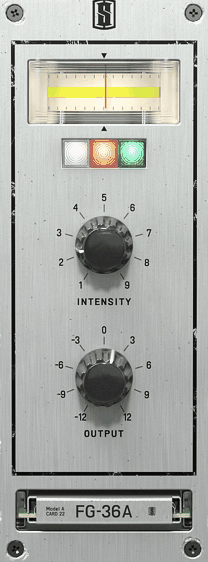
This one is modeled after a legendary 1960s exciter unit that helped define the sound of countless recordings from that era, and Slate Digital built it to live inside their Virtual Mix Rack environment. The FG-36A is about as straightforward as a plugin gets. There’s no deep menu diving, no hidden panels, no secondary modes to toggle between.
You open it, you turn one knob, and either it sounds better or you back it off. That simplicity is the entire point. I think where the FG-36A earns its keep is on sources that need a little high end presence without the risk of things getting thin or brittle.
It has a particular warmth to the way it generates harmonics that feels distinctly vintage, and I found it does an especially good job on vocals that need to cut through a dense arrangement without sounding like you just automated a high shelf.
- Two Knob Vintage Exciter Circuit
The entire interface consists of an Intensity knob and an Output knob, and that’s genuinely all there is to it. The Intensity control determines how much harmonic excitement is applied to the signal, while the Output manages your gain staging on the way out. I appreciate this design philosophy because it forces you to make decisions with your ears rather than getting lost in parameter tweaking.
The circuit is modeled to behave like the original hardware, which means the harmonic generation has a nonlinear character that responds differently depending on input level.
Feed it a hotter signal and you’ll get a slightly different tonal result than you would at lower levels, which gives you an additional dimension of control beyond just the Intensity knob itself. For anyone who’s tired of staring at complex interfaces when all they really need is a touch of sparkle, this is about as clean a workflow as you’ll find.
- Vintage Harmonic Character That Preserves Low End
One of the things that sets the FG-36A apart from more aggressive modern exciters is how it handles the relationship between the high frequency excitement and the low end of your signal. A lot of exciters can inadvertently thin out the bottom of a sound as they add top end energy, but the FG-36A was specifically designed to enhance the highs while keeping the low end completely intact.
I noticed this most clearly on 808s and bass heavy tracks where you want the top end attack to pop without losing any of the weight underneath.
The vintage circuit modeling contributes a subtle warmth to the harmonics that never sounds digital or sterile, and that coloration is a big part of what gives this plugin its musical character compared to cleaner, more clinical exciter designs.
For producers working in hip hop, pop, or any genre where low end integrity is non negotiable, this balance between top end sparkle and bottom end preservation is exactly what you want from a vintage style exciter.
- Virtual Mix Rack Integration
The FG-36A operates as a module within Slate Digital’s Virtual Mix Rack, which means you can chain it alongside other VMR processors like their 1176 emulations, LA2A models, SSL channel strips, and console emulations all within a single plugin window.
This is a genuine workflow advantage if you’re already invested in the Slate ecosystem, because you can build entire channel strips without opening multiple plugin windows or dealing with separate instances.
I found that placing the FG-36A after a compressor module and before a console emulation within VMR created a very cohesive signal chain that felt more like working with hardware than stacking individual plugins.
The tradeoff is that you need VMR to use it, so it’s not a standalone plugin you can drop into any insert slot on its own. For anyone already subscribed to the Slate Digital All Access Pass or who owns VMR with other modules, adding the FG-36A to the collection is an easy decision. But if you don’t currently use VMR, the requirement to work within that environment is something to factor into your decision.
2. Waves Aphex Aural Exciter
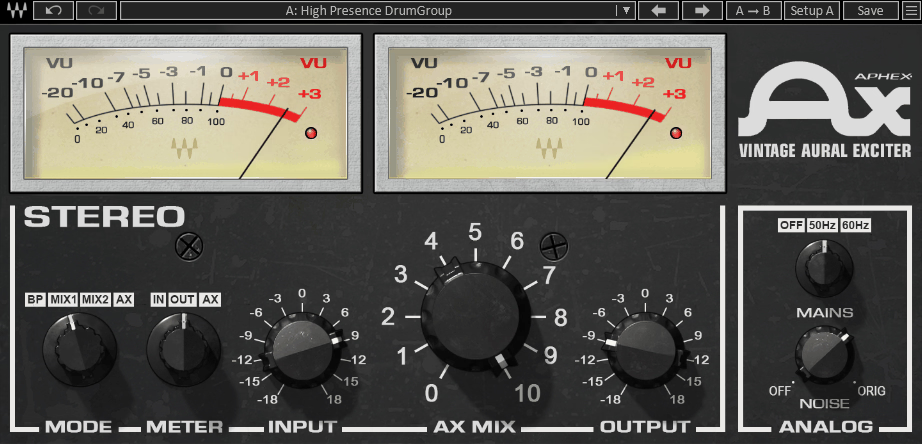
There’s a specific reason I keep coming back to this plugin on certain sessions, and it has nothing to do with nostalgia. The Waves Aphex Vintage Aural Exciter is modeled on the extremely rare original tube powered Model 402, which Waves obtained directly from Aphex’s storage to create this emulation.
Only a handful of these units were ever built, and the tube circuitry gives it a harmonic character that later solid state Aphex units never quite replicated. The excitement it generates is based on controlled second harmonic distortion, and the result is a brightness that feels fundamentally different from what you’d get with an EQ boost. This is a plugin that rewards patience and careful level matching.
The effect can be subtle at lower settings, almost imperceptible on first listen, but the cumulative impact across a mix becomes very apparent when you bypass it and suddenly everything feels flatter and less defined.
- Three Distinct Processing Modes
The plugin offers MIX1, MIX2, and AX modes, each producing a different sonic result even with identical knob positions. This exists because the original hardware behaved differently depending on whether it was patched into a channel insert or used through an auxiliary send and return path on the console. Waves modeled both behaviors and gave you access to each one.
MIX1 recreates the aux send and return sound when used as an insert, which is how renowned engineer Val Garay preferred to use the hardware. MIX2 provides the direct insert behavior, which tends to have a more pronounced and slightly different phase relationship with the original signal.
AX mode is designed for actual auxiliary send and return configurations within your DAW. I found that the differences between these modes are more significant than you might expect, and switching between them on the same source material can reveal surprisingly different results in terms of how the excitement blends with the dry signal. For most mixing scenarios, I’d recommend starting with MIX1 and only moving to the other modes if you’re looking for a different flavor of the effect.
- Input Driven Harmonic Response
Unlike exciters that separate the amount of effect from the input level, the Aphex Vintage Aural Exciter’s harmonic generation is heavily influenced by the input signal level. This means that the Input knob isn’t just a gain control but rather a fundamental part of shaping the tone and intensity of the excitement.
- Analog Noise and Hum Modeling
Waves included their analog noise modeling section with adjustable noise level and selectable mains hum at 50 Hz or 60 Hz, replicating the electrical characteristics of the original hardware’s power supply and circuit noise floor.
I’ll be honest that I rarely find a reason to add noise or hum back into a signal, but for anyone working on period accurate productions or trying to match the sonic fingerprint of recordings that were made through the real hardware, these options exist and are modeled with care.
- Lots of presets
The preset library includes custom settings from Val Garay himself, the celebrated mix engineer who was one of the most prolific users of the original hardware unit during the 1980s.
These presets cover a range of applications from individual instruments to full mix bus processing and even PA system configurations, and they serve as excellent starting points for understanding how the hardware was actually used by the engineers who knew it best.
I found the vocal and acoustic guitar presets particularly useful as jumping off points, because they demonstrate the range of subtlety that the plugin is capable of when handled with restraint.
It’s worth mentioning that this plugin works at resolutions up to 24 bit and 192 kHz in both mono and stereo configurations, making it suitable for both mixing and mastering duties.
The stereo component processes both channels simultaneously, which adds a cohesive quality to the excitement that can work particularly well on drum buses, grouped backing vocals, and full mixes where you want the entire stereo image to receive the same tonal treatment.
3. Arturia Bus EXCITER-104
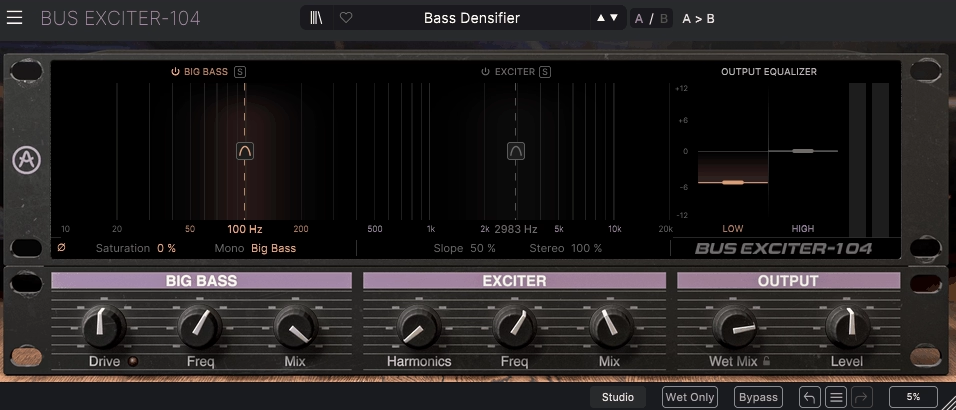
Arturia took a modernized approach with Bus EXCITER-104, building on the Aphex Type C2 Model 104 from the early 1990s but extending the design far beyond what the original hardware could do.
The C2-104 was the model that introduced the “Big Bottom” feature alongside the traditional high frequency excitement, and it became one of the most commercially successful exciters ever made.
What Arturia has done is keep the core sonic character of that unit while adding a real time frequency visualizer, extended parameter ranges, and a modern interface that gives you far more visual feedback and precision than the original rack unit ever offered.
I think the dual module design is what makes this plugin particularly versatile. Being able to work on the lows and the highs independently within the same plugin means you can address both ends of the spectrum without stacking separate processors. The interface walks the line between vintage inspired aesthetics and modern software usability, and it does so convincingly.
- Dual Module Architecture with Independent Low and High Processing
The plugin splits its processing into two completely separate sections. The Big Bass module shapes the low end between 20 Hz and 200 Hz by dynamically increasing the perception of bass frequencies through harmonic generation rather than simple level boosting.
The Exciter module handles the high frequency enhancement with controls for adjusting harmonics to shape the texture and detail of the processed signal.
Each module has its own set of controls and can be engaged or bypassed independently, so you can use the plugin purely as a low end enhancer, purely as a top end exciter, or both simultaneously.
I found this dual approach especially effective on full mix bus applications where you want to add weight to the kick and bass while simultaneously opening up the top end of the cymbals and vocals, all from a single insert point. The Big Bass section includes an LED response indicator that should pulse on bass peaks, which helps you visually gauge when you’ve found the sweet spot for your source material.
- Audio Spectrum Visualizer with Color Coded Feedback
A large real time frequency display sits at the center of the interface, showing you exactly which frequencies are being affected by both the Bass and Exciter modules simultaneously. The display uses color grading from light red to purple to represent the relative spread of the two processing areas, making it immediately obvious where your enhancement is concentrated.
- Solo and Mute Buttons for Isolated Monitoring
Each processing module includes dedicated solo and mute buttons that let you hear exactly what the Bass or Exciter section is adding to the signal in isolation. The Wet Only toggle is particularly valuable because it lets you audition nothing but the generated harmonics and processing artifacts, stripped of the dry signal entirely.
- Output Equalizer for Final Tone Shaping
After both processing modules have done their work, the signal passes through an output equalizer that lets you make final adjustments to the tonal balance of the processed signal.
4. Softube Weiss Exciter
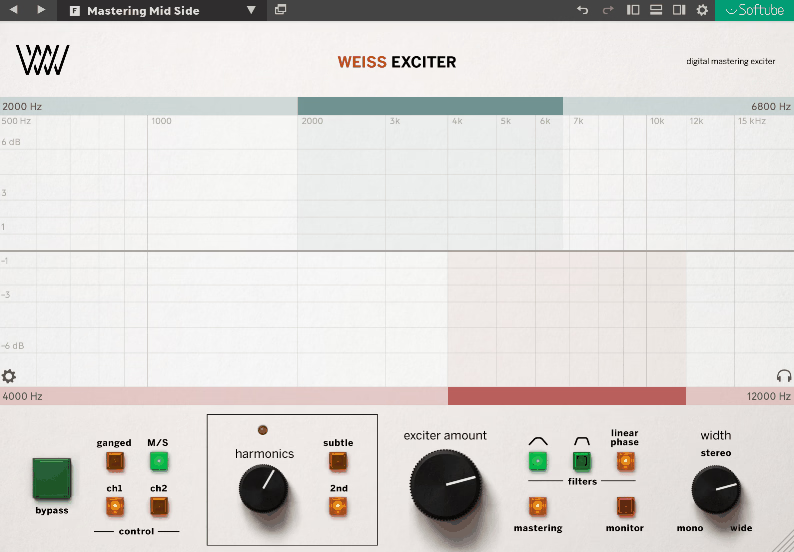
If transparency is your primary concern, this is probably the most technically sophisticated exciter plugin currently available.
Developed as a collaboration between Softube and Weiss Engineering, the company behind some of the most respected mastering hardware in existence, the Weiss Exciter was designed from the ground up to answer a specific question: can you add harmonic excitement without any of the typical side effects that make exciters problematic in mastering contexts? The answer, based on my experience with it, is that they got remarkably close.
The engineering behind this plugin is genuinely impressive. Every aspect of the harmonic generation has been mathematically designed to minimize unwanted coloration while still producing the perceptual effect of increased brightness and presence.
This is not a vintage emulation trying to recreate the quirks of old hardware but rather a ground up modern design built by people who understand mastering at the highest level.
- Adaptive Non Linearity for Level Independent Processing
Traditional exciters generate different amounts of harmonics depending on the input signal level, which means loud transients get more excitement than quiet passages, leading to an inconsistent and sometimes harsh result.
The Weiss Exciter solves this with adaptive non linearity, a processing approach that keeps the harmonic generation musically consistent regardless of how loud or quiet the incoming signal is.mics. For mastering engineers working with material that has wide dynamic range, this single feature alone justifies serious consideration.
- Mastering Switch for Fundamental Frequency Reduction
This is the feature that most clearly separates the Weiss Exciter from everything else on this list. Engaging the Mastering switch mathematically reduces the fundamental frequencies from the generated harmonics, so that only the newly created harmonic content affects the sound.
In practical terms, this means you get the perceptual brightness and sparkle of an exciter without the EQ like level boost that normally accompanies it.
- Four Mathematically Designed Harmonic Modes
Rather than modeling the harmonic behavior of a specific piece of hardware, Softube and Weiss mathematically engineered four distinct harmonic generation algorithms from scratch.
Soft and Hard modes provide predictable and smooth results with different amounts of harmonic density, while Poly 3 and Poly 5 modes are designed for maximum transparency with polynomial saturation curves that produce fewer intermodulation artifacts.
Each mode generates a different harmonic series with different relative levels of odd and even harmonics, giving you four genuinely distinct flavors of excitement to choose from.
I found Poly 5 to be the most transparent option for mastering bus work, while Hard mode worked better on individual tracks where a more audible enhancement was desirable. The fact that these algorithms were designed mathematically rather than empirically means they behave predictably and consistently across different types of source material, which is exactly the kind of reliability mastering engineers need.
- Phase Compensated Parallel Signal Path
The Weiss Exciter uses a fully parallel architecture where the dry signal passes through the plugin completely unaffected, and the generated harmonics are added alongside it. All internal filters are phase compensated to prevent cancellation effects between the added harmonics and the original audio, which is a detail that matters enormously at mastering levels of scrutiny.
- Dual Channel Processing with Mid Side Support
The Weiss Exciter can operate in linked stereo, independent left and right, or mid and side configurations, giving you the flexibility to apply different amounts of excitement to different parts of the stereo field.
Each channel gets its own independent Harmonics level and filter frequency settings, so you can excite the sides more aggressively than the mid to add width, or focus the excitement on the center channel where the vocal lives while leaving the sides untouched.
I found the mid side capability particularly useful in mastering, where adding a small amount of excitement to just the side channel created a noticeable sense of spaciousness and shimmer without affecting the punch and focus of the center image.
5. Slate Digital Fresh Air (Free)
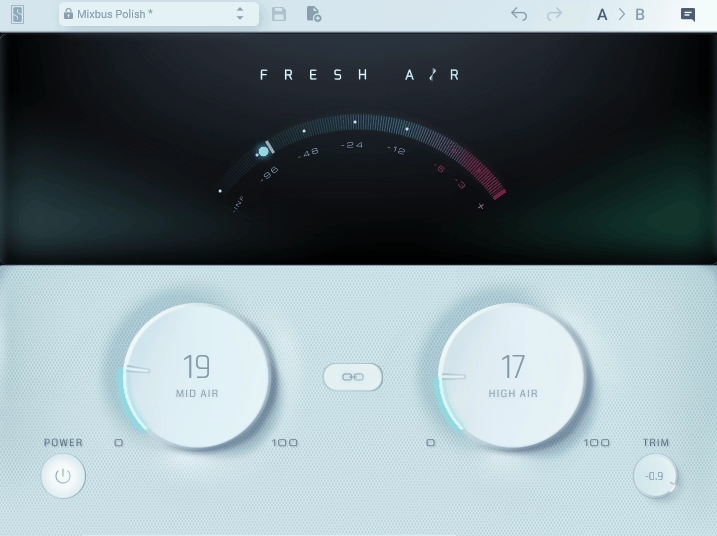
Slate Digital’s Fresh Air has quietly become one of the most widely used mixing tools in modern production, and for good reason.
It’s based on the classic Dolby A noise reduction mod technique that engineers in the 1960s and 70s discovered when they realized that running a signal through a modified Dolby A301 or 361 unit with the lower bands disabled would compress and enhance only the high frequencies, adding a beautiful sheen to recordings without the harshness that traditional EQ boosting would introduce.
Fresh Air takes that concept and wraps it in a plugin so simple that you can be getting results within literally seconds of opening it for the first time. I’ve seen this plugin on vocal chains, drum buses, and master faders in sessions from bedroom producers to Grammy nominated engineers, and the reason is always the same: it just works.
The processing doesn’t generate harmonics in the traditional exciter sense but instead uses parallel high frequency compression that brings existing high frequency content forward in a smooth and controlled way.
- Dual Band Dynamic High Frequency Processing
Fresh Air provides two overlapping high passed, gently compressed bands that can be mixed into your signal independently. The Mid Air knob boosts upper midrange presence, targeting the frequency region where vocals and instruments need to cut through a mix, while the High Air knob adds brilliance and top end shimmer in the highest octaves.
What makes this different from simply automating a high shelf EQ is that Fresh Air is a dynamic process, meaning it’s not just adding level but actively compressing and enhancing the high frequency content in a way that brings quieter high frequency details forward without making already bright transients harsher.
I found this distinction becomes most apparent on vocal recordings where sibilance is a concern, because Fresh Air tends to enhance the body and air of the voice more than it emphasizes the sharp sibilant peaks. The magic of Fresh Air really becomes apparent when using both knobs together, and the interaction between the two bands creates a compound effect that’s more musical than either band in isolation. Many producers report that once they hear the difference Fresh Air makes, they end up putting it on nearly every vocal chain and mix bus in their sessions.
- Link Button for Proportional Adjustment
The Link function locks the Mid Air and High Air knobs together so they move proportionally when you adjust either one. This might sound like a minor convenience feature, but I found it genuinely useful during fine tuning because it lets you explore the overall amount of excitement while maintaining whatever ratio you’ve established between the two bands.
Without the link, adjusting one band at a time can sometimes lead you down a path where the mid and high balance drifts away from where it sounded best, and having to constantly readjust both knobs slows down the workflow.
With the link engaged, you can quickly find the overall intensity that works and then disengage it to make final tweaks to the individual band levels. This is a small but thoughtful workflow detail that shows Slate Digital put genuine consideration into how people actually use this kind of tool in real sessions.
The link ratio is preserved from wherever you set the knobs before engaging it, so it adapts to your preferred balance rather than forcing a fixed relationship.
6. Techivation T-Exciter
Techivation has been quietly building a reputation for plugins that take common mixing tasks and execute them with unusual smoothness and musicality, and the T-Exciter is a perfect example of that philosophy.
What struck me first about this plugin was how it’s been described by professional reviewers as capable of a particularly smooth result, and after spending time with it I understand exactly what they meant. There’s a quality to the harmonics this plugin generates that avoids the brittle, fatiguing edge that gives exciters a bad reputation, and it gets you to musically useful results faster than most competitors.
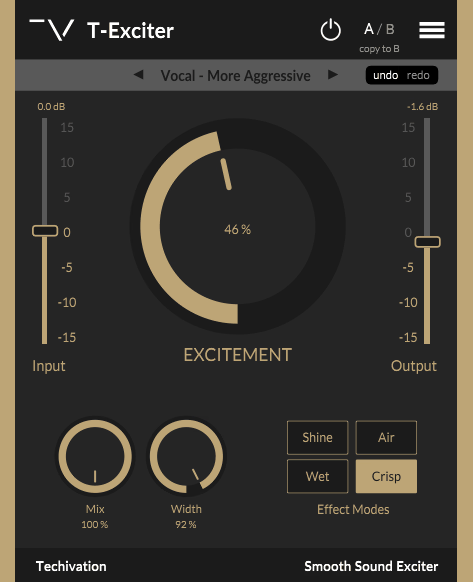
The interface follows Techivation’s consistent design language: clean, compact, scalable, and focused on getting out of your way so you can actually listen. The GUI can be scaled from 80% to 150% to fit your screen and workflow preferences, and the overall aesthetic is modern without being distracting.
- Four Distinct Effect Modes for Different Flavors of Excitement
T-Exciter offers four selectable modes, each producing a fundamentally different type of harmonic enhancement. Shine makes sounds sharper and more detailed by emphasizing upper harmonic content. Air adds open, breathy high frequency energy that creates a sense of space.
Wet glues sounds together and adds overall cohesion with a broader excitement. Crisp pushes sounds forward in the mix and helps them cut through dense arrangements.
I found that switching between these modes on the same source material produced remarkably different results, far more different than you might expect from a plugin with such a simple interface.
The Air mode became my favorite for vocal work because it added exactly the kind of openness I usually chase with shelf EQ moves, but with a smoother delivery that never crossed into harshness even at higher settings. The Crisp mode proved especially useful on acoustic guitars and piano tracks where I wanted the instrument to sit more prominently in the mix without simply making it louder or brighter in a conventional sense.
- Stereo Width Enhancement
Beyond harmonic excitement, T-Exciter includes a dedicated Width control that can expand the stereo image of your signal as part of the same processing chain. I think this is a smart inclusion because the two effects often complement each other beautifully.
Adding top end excitement alongside subtle width enhancement creates a sense of depth and dimension that neither effect achieves as effectively on its own.
The Width control works especially well on mono or narrow sources where you want to create a wider perception without resorting to a separate stereo imaging plugin, and it integrates seamlessly with whichever effect mode you’ve selected.
I noticed it pairs particularly well with the Air mode on backing vocals and pad sounds where a sense of expansive space is desirable. The widening is applied tastefully enough that it doesn’t create phase problems on mono playback systems, which is an important consideration for any content that might be heard through phone speakers or mono club systems.
- Up to 8x Oversampling for Clean Harmonics
Any plugin that generates harmonics through nonlinear processing risks creating aliasing artifacts, which are unwanted frequencies that fold back into the audible spectrum and can make the excitement sound gritty or digital.
T-Exciter addresses this with oversampling up to 8 times the host sample rate, which pushes those aliasing artifacts well above the range of human hearing. I found the difference between no oversampling and 8x most noticeable on sources with a lot of high frequency content already present, like cymbals and bright synthesizers, where aliasing can become audible more easily.
7. Black Salt Audio Oxygen
Black Salt Audio has earned a following by making plugins that do very specific things extremely well, and Oxygen is their take on top end enhancement with a twist.
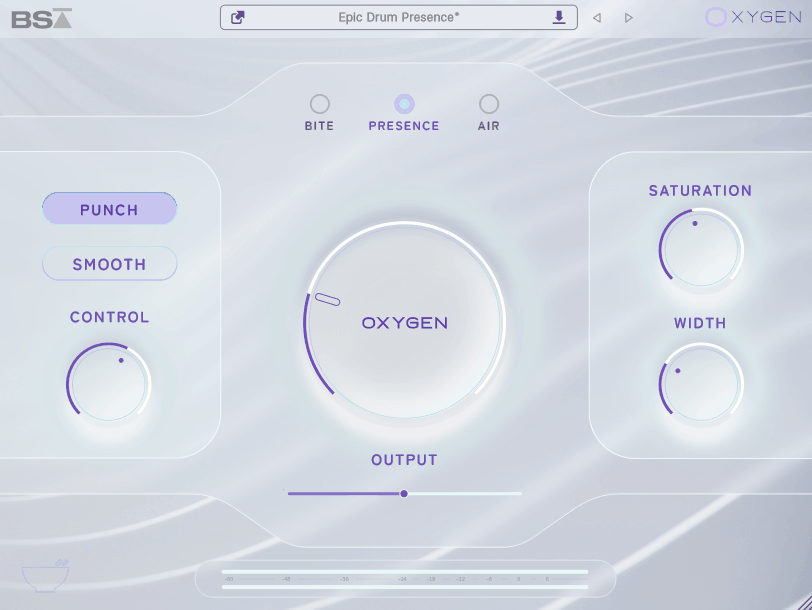
Rather than being a pure harmonic exciter, BSA Oxygen combines three separate processors into a single focused tool: an exciter section with three selectable modes, a built in compressor with two characters, and a saturation module.
The result is something that sits at the intersection of exciter, dynamic processor, and tonal shaper, and it approaches the problem of top end enhancement from a more holistic angle than most dedicated exciters.
What I appreciate about the design philosophy here is that it acknowledges a reality most producers encounter: when you’re trying to improve the top end of a track, you usually need more than just harmonic generation.
You need control over the dynamics of those frequencies, and you need the warmth that comes from tasteful saturation to keep things smooth. Oxygen puts all three of those tools in a single, cohesive interface and lets them work together rather than requiring you to stack separate plugins.
- 30 Professional Presets from Working Engineers
Oxygen ships with over 30 presets created by professional producers and mix engineers including Henrik Udd, Max Cameron, and Forrester Savell. These aren’t generic factory presets designed to show off the plugin’s range but rather real world starting points created by people who use tools like this every day on actual releases.
- Three Oxygen Types Targeting Different Frequency Ranges
The main exciter section offers three distinct modes that each focus on a different region of the upper frequency spectrum. Bite adds midrange attack and definition, which is useful for helping guitars, snares, and vocals punch through a mix.
Presence brings forward clarity in the upper midrange where intelligibility and cut live. Air delivers open, airy brilliance in the highest octaves for shimmer and sparkle on cymbals, vocal air, and master bus polish.
I found that choosing the right mode for the source material was the single most important decision when using Oxygen, because each one targets a different problem area and using the wrong mode can add energy where you don’t need it while ignoring the region that actually needs help. Bite on a snare drum versus Air on the same snare produces completely different results, and neither is inherently better.
- Dual Mode Compressor for Dynamic Top End Control
The built in compressor is not a full featured dynamics processor but rather a focused tool designed specifically to shape the dynamic behavior of the excited signal. Punch mode emphasizes transients and increases the attack of the high frequency content, making it pop and snap.
Smooth mode provides a softened dynamic response that rounds off peaks and creates a more controlled, silky high end.
- Saturation Module for Warm Harmonic Enhancement
Sitting alongside the exciter and compressor is a saturation stage that adds harmonics and subtle imperfections to the high frequencies. The key here is that the saturation is designed to make boosted high frequencies sound warmer and richer rather than thinner and more brittle, which counteracts the common problem with exciter plugins where pushing the brightness eventually leads to listening fatigue.
- Side Enhancer for Stereo Width
The stereo version of Oxygen includes a Side Enhancer that selectively widens the high frequency content of your signal without affecting the center image or the lower frequencies. This works by enhancing the side channel information specifically in the upper part of the spectrum, which creates a perception of width and shimmer that extends beyond the speakers without making the overall stereo image feel unfocused or unstable.

Hello, I’m Viliam, I started this audio plugin focused blog to keep you updated on the latest trends, news and everything plugin related. I’ll put the most emphasis on the topics covering best VST, AU and AAX plugins. If you find some great plugin suggestions for us to include on our site, feel free to let me know, so I can take a look!