
For many plugins on this site, you can find a free trial on the developer’s website. However, when you purchase through PluginBoutique or other authorized vendors, you’re directly supporting Pluginerds.com. Thank you for your support.
When it comes to organ plugins, they recreate the tonewheel physics, pipe resonance behavior, and rotary speaker movement that made classic organs the foundation of gospel, jazz, rock, and sacred music before digital workstations became the standard.
With that being said, I would like to share with you some of the best organ plugins I found for producers and composers who need convincing Hammond tonewheel grit, physical pipe organ realism, and Leslie rotary character without the space requirements, tuning headaches, or $50,000+ price tags that real vintage organs demand.
I will talk about these plugins specifically: Modartt Organteq 2, Arturia B-3 V, UAD Waterfall B3 Organ, and few more plus three capable free picks that deliver genuine organ behavior without the cost.
Standard synth organs generate basic drawbar sounds but miss the tonewheel leakage, key click mechanics, and rotary speaker coupling that made real organs cut through dense mixes and sit naturally in arrangements across decades of professional recordings. On the flip side, real tonewheel organs shape sound through electromechanical tone generation that creates natural harmonic complexity. Now, let’s dive into the post.
1. Modartt Organteq 2

When it comes to pipe organ plugins, most developers take the sampling route because it’s proven, but Modartt Organteq 2 commits entirely to physical modeling instead, which means you’re getting an instrument that generates sound based on actual organ physics rather than playing back recordings.
That being said, this isn’t just a technical curiosity, it’s the reason Organteq behaves like a real pipe organ under sustained playing where most sampled organs start revealing their limitations.
I find that the difference becomes obvious the moment you hold chords for more than a few seconds. With sampled organs, you’re hearing loops that eventually feel static, but with Organteq the sound keeps evolving naturally because the modeling engine continuously calculates how air pressure, pipe resonance, and acoustic coupling interact in real time.
For instance, when you’re working on sacred music or film scoring where long sustained passages define the emotional weight, this organic behavior stops your mockups from sounding frozen or mechanical.
- Physical Modeling That Responds Like a Real Instrument
The synthesis engine calculates every note mathematically based on how real pipe organs function, which eliminates the need for samples, velocity layers, or round robins entirely. I like how this approach allows the instrument to respond continuously to changes in wind pressure, key action, and pipe behavior, so articulations feel organic rather than triggered.
When you’re playing fast passages or making sudden dynamic shifts, the modeling adapts in ways that sampled organs simply cannot replicate because they’re locked into pre-recorded behaviors. Also, the physical modeling means you never run into memory limitations or disk streaming issues that plague large sampled libraries.
You get instant load times, efficient CPU usage, and the ability to scale the instrument across different systems without worrying whether your computer can handle the sample pool.
- Authentic Construction and Deep Control
Also, I would like to mention where Organteq really distinguishes itself is in how it handles organ construction rather than just giving you a preset browser. You’re working with actual stop management, manual assignment, and pedal control the way a real organist would approach a physical instrument.
For instance, when you need to replicate a specific historical organ, you can adjust pipe scaling, voicing, and wind system behavior to match your reference. I find this depth valuable when you’re working on period-accurate classical music or need to match a specific organ sound for a film cue.
Instead of hoping a preset gets close enough, you’re building the exact instrument you need from the ground up. That being said, this level of control does mean you need to invest time learning how organs actually work.
- Room Modeling and Spatial Realism
In addition to that, Organteq includes integrated acoustic modeling that lets you place the organ in different virtual spaces without relying entirely on third-party reverbs. You can shape how the instrument interacts with the room, which is critical for pipe organ realism because the room is effectively part of the instrument in real life.
This makes the plugin particularly effective for film scoring, classical mockups, and sacred music where space and decay are as important as the tone itself.
2. Arturia B-3 V3

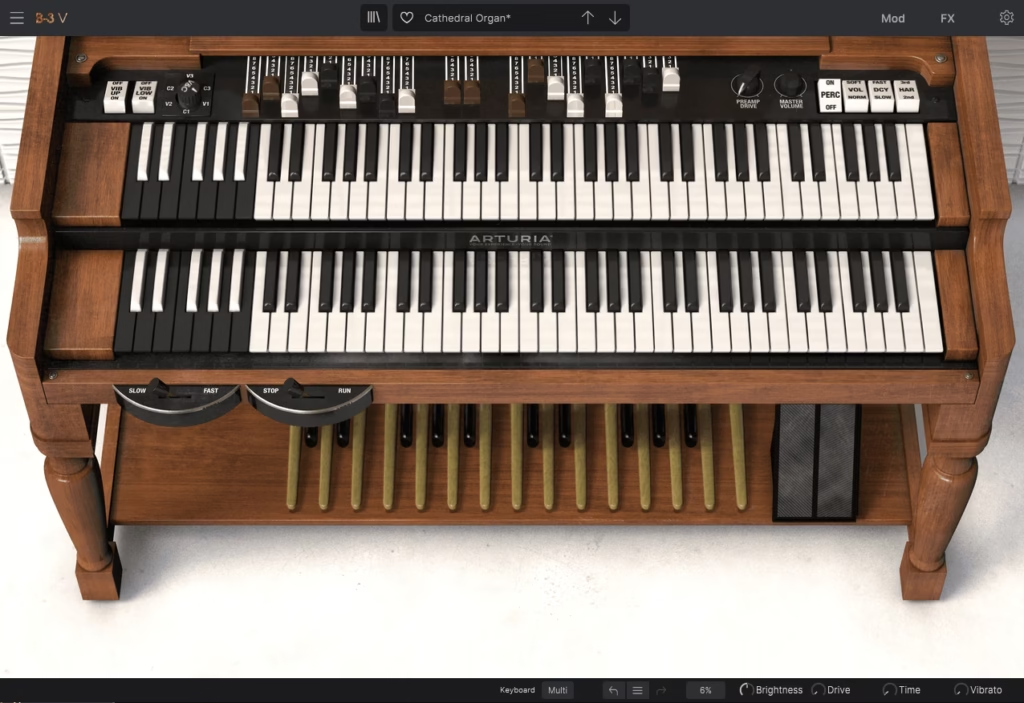
Arturia B-3 V3 delivers the full classic Hammond-style rig experience as an integrated instrument, meaning the organ itself and the rotary speaker are treated as one unified system instead of two separate problems you have to solve with extra plugins.
Arturia positions it as capturing the classic organ’s grit and grind while adding modern modulation, FX, and sound design layers, and in practice that’s exactly how it behaves. It can be a straight-up traditional organ plugin, or a modern animated texture machine depending on how deep you go into the modulation options.
- Tonewheel Realism: What You Can Actually Control
B-3 V doesn’t just give you drawbars and call it a day. It exposes the controls that matter for realism and feel, including tonewheel leakage, drawbar leakage, key click level, background noise, and brilliance.
I think these parameters are what separate “generic organ sound” from “that specific Hammond-like behavior,” because leakage and click are exactly where the personality lives when you play staccato lines, palm smears, and fast comping. You can dial in how much mechanical character you want, which becomes critical when you’re trying to match a specific vintage vibe or need the organ to sit naturally in a period-accurate production.
- Percussion Behavior: Authentic Plus a Useful Modern Option
Percussion is a huge part of the classic tonewheel sound, and B-3 V includes a full percussion section, plus an optional polyphonic percussion mode. I would recommend exploring this option because it’s not “historically strict,” it’s “musically useful,” especially for modern chords and layered parts where you want the percussive bite on more than one note at a time.
This becomes particularly valuable when you’re working on contemporary productions where you need that classic percussive attack but can’t be limited to monophonic behavior. The traditional mode is there when you need authenticity, but having the polyphonic option opens up creative possibilities that real hardware simply couldn’t deliver.
- Rotary Speaker: The Part That Makes It Sit in a Mix
B-3 V is built around the idea that the rotary speaker is inseparable from the instrument, so the rotary simulation is a core component, not a throw-in. I find this integration critical because getting an organ to feel “record-ready” usually means the rotary behavior is just as important as the tone generation itself.
The plugin includes traditional switching behavior for speed states, which is exactly what you need when you’re performing or programming dynamic organ parts that shift character between sections. Instead of patching external rotary plugins and hoping they gel tonally, you’re working with a matched system that behaves the way classic rigs actually behaved.
- Modulation and “Modern Organ” Motion
This is where B-3 V pulls ahead of more conservative emulations. It includes drawbar modulation tools such as LFO, multi-stage envelope, and step sequencer, letting you animate registrations in ways that are extremely hard to do on real hardware.
I would say if you want an organ part that evolves rhythmically, pulses with the track, or morphs from thin to huge over time without drawing automation lanes for every drawbar, this feature set matters enormously. You can create movement and texture that would be nearly impossible to achieve with traditional drawbar riding, which opens up the plugin for modern production techniques beyond straight vintage emulation.
- FX and Routing Flexibility
B-3 V includes an internal FX section intended for complete “organ rig” builds inside one plugin, including options like reverb and other mix-oriented effects, so you can go from dry studio organ to processed stage rig without patching multiple inserts. I find it useful in real sessions because organ tones often need quick context switching: clean for verses, more drive and motion for choruses, wetter for bridges.
Having everything integrated means you’re making faster decisions and spending less time building signal chains just to hear what the part should actually sound like in context.
- Controller Mapping and Playability
For any serious organ plugin contender, playability is non-negotiable. B-3 V is designed to be played with mapped drawbars and switches, and it supports the classic performance workflow of riding drawbars and changing rotor speed live.
I would recommend setting up proper controller mapping if you’re planning to use this for performance or live recording, because the plugin really comes alive when you’re interacting with it dynamically rather than just programming MIDI. That being said, some users run into mapping quirks when trying to build dual-manual controller rigs, which is worth knowing if you’re planning an elaborate live setup.
3. UAD Waterfall B3 Organ

Universal Audio built Waterfall B3 Organ as a complete “whole rig” solution rather than just another tonewheel organ plugin, and that distinction matters more than it might seem at first. At first glance, the plugin is designed around one clear outcome: a convincing B-3 style sound that already feels mixed and record-ready without needing a chain of external processors to get there.
UA pitches it as their deepest emulation of the classic instrument and its companion rotary cabinet, and I noticed that the feature set backs that up with detailed modeling of both the organ’s internal behavior and the speaker/mic chain that usually defines the final sound you hear on records. In my opinion, this “whole rig” approach is what separates it from plugins that just give you drawbars and expect you to figure out the rest.
- Organ Model Depth: What’s Actually Being Emulated
This isn’t presented as a generic drawbar organ. UA describes Waterfall B3 as a completely circuit-modeled 1958 tonewheel organ, and they call out specific realism behaviors that matter in practice, like transformer “pumping” and upper-harmonic drawbar interactions.
I think these details aren’t just marketing buzzwords, they’re the kind of non-ideal interactions that help an organ feel like hardware when you change registrations, layer dense chords, or push the sound into drive. To me, the tone reacts like a system instead of a static oscillator mix, which is exactly what makes the difference between “sounds like an organ” and “sounds like that specific organ.”
- Rotary Cabinet Realism
A huge part of the Waterfall identity is the rotary cabinet side. UA emphasizes the three-dimensional movement, speaker breakup, and full tonal range of the legendary Type 147 / Leslie 147-style cabinet, captured with expertly placed vintage mic setups.
I noticed that the “finished sound” goal becomes very clear when you consider they’ve modeled tube power amp saturation and shaped the cabinet tone through mono and stereo vintage mic perspectives. This is exactly how organ tones end up sounding “real” in records rather than just “organ-ish” in isolation, because you’re hearing the complete signal chain as one cohesive instrument.
- Spring Reverb: Not an Afterthought
In addition to the organ and cabinet modeling, Waterfall B3 includes a modeled spring reverb based on Accutronics tank designs, and this matters because organ parts often need a specific “amp/rig” ambience that’s different from a clean studio hall. I would say having spring inside the instrument helps you get a complete, era-correct vibe quickly, especially for blues, soul, gospel, and vintage rock textures where the reverb is part of the character and not just mix glue.
- Presets and “Record-Ready” Workflow
UA leans hard into the idea that this is a fast, usable instrument, and the plugin includes 70+ hand-crafted presets designed for album-ready results. To me, this is a practical strength because dialing a convincing organ tone is usually a chain decision, meaning registration plus percussion/vibrato behavior plus rotary state plus breakup plus mic perspective plus space.
- Performance Features: Split, Manuals, and Hands-On Control
At first glance, the Keyboard Split functionality might seem like a minor feature, but I think it’s a big deal for realistic B-3 style playing when you only have one controller. In practice, this lets you cover the “upper vs lower manual” behavior without a dual-manual rig, which is often the difference between “I can perform this part” and “I can only program it.”
In addition, the plugin includes MIDI-mapped parameters for real-time control, which matters because organ is a performance instrument where rotary speed changes, percussion toggles, and registration moves are part of the playing style, not post-edit chores.
- How It Sits in Real Mixes
I noticed that users comparing Waterfall B3 to other popular organ emulations mention it’s more mid-forward than alternatives, which is actually a useful mix note because it hints at why the plugin can feel present in rock/pop contexts without excessive EQ. In my opinion, this forward character combined with the integrated cabinet modeling means the organ naturally finds its space in arrangements without fighting for position.
4. IK Multimedia Hammond B-3X
If your goal is authentic Hammond tonewheel behavior instead of a generic drawbar synth, you need an instrument that goes beyond surface-level emulation and actually models the details that make a real B-3 feel alive under your hands.
Most organ plugins give you drawbars and a rotary effect, then expect you to figure out the rest with external processing and hoping everything gels tonally. IK Multimedia Hammond B-3X takes a different approach by recreating not only the sound, but the controls and the entire classic signal path you’d expect from a real B-3 rig, and it’s built in official collaboration with Hammond USA and Suzuki which adds legitimacy to the modeling decisions.
In practice, that shows up as an instrument that feels engineered around the details that matter to organ players: tonewheel behavior, leakage, key click, percussion, chorus/vibrato, and a deeply integrated Leslie chain. I like how B-3X doesn’t try to simplify the Hammond experience into something “user-friendly” at the cost of authenticity, instead it gives you the messy, characterful controls that actually define how a Hammond sits in a track.
- Tone Generation Realism
A big reason B-3X gets called “real” is how it approaches tone generation. IK models 91 free-running tonewheels and mixes them in real time based on the notes you play and your drawbar settings, which mirrors the concept of a real tonewheel generator rather than a static oscillator bank.
For instance, when you play sustained chords, do fast legato runs, or ride drawbars mid-phrase, this “free-running” approach is part of what helps the sound feel less frozen and more like hardware. I think this technical foundation is what separates B-3X from simpler emulations that might sound convincing in isolation but start revealing their limitations once you’re actually performing with them across multiple registers and dynamic ranges.
- The Controls That Define a Real Hammond Feel
B-3X leans into the “messy” parts of a Hammond that are crucial for believability. It exposes editing around generator leakage, key click, tonal balance, plus core Hammond behaviors like percussion and chorus/vibrato.
I like how these aren’t treated as bonus features but as fundamental controls, because they’re the stuff that makes an organ sit correctly in a track. Key click and leakage create presence and grit, percussion gives you that classic bite for stabs and comping, and chorus/vibrato is a huge part of the signature movement when you’re not living entirely on the rotary speaker. If you would ask me what makes a Hammond emulation feel authentic versus generic, it’s exactly these kinds of imperfections and mechanical behaviors that define the character.
- Drawbar Workflow
A practical production detail is that B-3X supports multiple drawbar sets per preset, described as 24 custom drawbar settings within a preset. The value here isn’t “more presets,” it’s that you can treat one patch like a performance: verse registration, chorus registration, solo registration, all living inside the same instrument state so you can switch quickly without rebuilding the sound each section.
Personally, I think if you play Hammond parts the way they’re meant to be played, this kind of registration switching is a big part of why the instrument feels “alive” in an arrangement. You’re not jumping between separate presets and hoping the transitions feel natural, you’re working within one coherent instrument that adapts to the musical context.
- Leslie and the Full Rig Chain: Amps, Cabinets, Mics, Mixer
B-3X is not “organ only,” it’s built as a full rig, and that’s a major reason it lands in “best organ vst” conversations. It includes an official Leslie-style rotary section with multiple microphones, plus a selection of power amp and cabinet models you can mix and match, and even a full-featured mixer and post-mixer effects.
I like how the point here is that you’re not stuck with one rotary flavor or one mic perspective, you can dial how the cabinet hits the track like you would in a studio session. For instance, you might want a more distant, room-heavy perspective for a ballad, then switch to a close, aggressive mic setup for a rock chorus, and B-3X lets you make those decisions within the instrument rather than needing separate rotary plugins for different tonal goals.
- Stompbox Pedalboard and Post Effects
IK also bakes in a pedalboard-style section that’s meant to reflect real-world Hammond setups where players often hit the rig with effects. The plugin includes five dedicated stomp box effects in a fixed serial chain placed after the organ output and before the Leslie, which makes sense because that’s how you’d typically patch it in reality.
Personally, I think this matters for modern production because you can get convincing organ tones that already have the right contour and attitude without immediately reaching for external saturation, modulation, or filter tools. You’re building complete, finished sounds inside one instrument rather than assembling a complex effects chain across multiple plugin windows..
- Parallel Guitar Amp Section
Lastly, one of the more unique additions is the parallel guitar amp path with amp models and a 4×12 cabinet, which is not a traditional Hammond requirement, but it’s a legitimately useful production option if you want more aggressive rock tones or gritty midrange push.
If you would ask me when this becomes valuable, it’s exactly in that Jon Lord / hard rock organ lane where “organ as a distorted lead instrument” is the point, and you need that amped character sitting forward in the mix without relying only on rotary drive.
5. AIR Organ

If you’re looking for a tonewheel-style organ plugin that prioritizes workflow speed and practical feature sets over exhaustive emulation depth, it delivers exactly that balance without compromise.
AIR Organ is a modern, streamlined plugin built for producers who want authentic drawbar control and classic rotary movement without needing a massive “full Hammond rig” interface that takes forever to navigate.
- Tone Generation and the “10 Tonewheel Sets” Approach
Instead of claiming one ultra-purist model of a specific year of B-3, AIR Organ leans on ten selectable tonewheel sets to move the core character around fast. I think this approach is useful because you can pick from different base “flavors” and then shape them with drawbars and drive.
Practically, this means you can jump from cleaner, smoother organ beds to brighter or dirtier lead tones without rebuilding the whole chain, and without having to dig through external cabinets and saturation plugins just to find the right starting point.
- Nine Drawbars
It includes nine drawbars, which is the real “hands-on” control that makes tonewheel organs feel like instruments instead of presets. I feel like drawbars are what separate authentic organ workflow from generic preset browsing, because you’re blending harmonics to build anything from thin reediness to thick, round body.
In a DAW context, you can automate drawbars or map them to MIDI and treat registration changes like performance moves, not static sound design decisions. For instance, you can ride drawbars during a solo section to add intensity, then pull them back for verses, and the organ responds musically rather than feeling like you’re just tweaking parameters.
- Realism Controls
Two small parameters tend to decide whether an organ part feels convincing in a track: drive and key click. AIR Organ puts both right up front with Amp Drive and Key Click controls that are easily accessible and musical to use.
I must say drive matters because a lot of “real” organ tone is actually preamp/amp behavior, especially for rock, blues, and aggressive lead parts where you need that pushed, saturated character. In addition, key click adds that percussive front edge that helps an organ speak clearly through a mix, especially in rhythmic comping where the attack definition is critical for groove and clarity.
- The Movement Layer
It includes scanner vibrato and rotary speaker simulators as built-ins and I feel like the scanner vibrato is one of the signature “motion” sounds associated with classic organs when you want movement without committing fully to rotary swirl.
Rotary simulation is the other half of the classic organ story, and AIR’s positioning makes it clear you’re expected to stay inside the plugin to get a complete sound quickly. I appreciate how this integrated approach means you’re not patching multiple plugins just to get basic organ movement and spatial character working together tonally.
- Built-In Effects
AIR’s product approach is direct about the goal: built-in effects are there so you can land a usable tone in minutes. In practice, I feel like this is a big reason AIR Organ can be the right pick even if you own heavier flagship organs.
- Where it Fits in a “Real Sound” List
AIR Organ is best when you want a clean, controllable tonewheel organ plugin that gets you the essential Hammond-style workflow, meaning drawbars, vibrato, rotary, drive, and key click, without overwhelming you with deep mic/cab matrices and complex routing.
I think it’s the kind of organ plugin that works especially well for producers building tracks fast, layering organ under guitars and keys, or needing organ hooks that land immediately with minimal tweaking.
Freebies:
1. Sampleson CollaB3

Sampleson CollaB3 V2 is one of the strongest “real sound” options in the free organ plugin world because it focuses on the details that actually make a Hammond-style instrument feel convincing in a mix: tonewheel character, leakage, key click, percussion, and a rotary section that behaves like a real rig instead of a generic swirl.
What stands out to me is that the Free version and the Pro version share the same core sound engine, so the free one isn’t a “lite demo” tone-wise, it’s the full instrument with fewer editing controls.
- Sound Engine
CollaB3 V2 is built around a rebuilt spectral-modeled sound engine, which is Sampleson’s approach to recreating the tonewheel behavior without leaning on huge sample sets. In the V2 update, Sampleson explicitly calls out new key-click noises, new leakage, and improved CPU efficiency, all of which matter because the “realism” of B-3 style parts often comes from those non-musical components sitting under the notes.
From what I can see, CollaB3 tends to hold up over long performances because the sound doesn’t feel like a static loop, it feels like a living circuit with noise, bite, and movement.
- Core Organ Controls
Both versions give you the practical controls you expect from a tonewheel organ plugin, including 8 drawbars, click intensity, percussion selection, organ reverb, leakage emulation, rotary speaker emulation, and a rotary speed switch.
That’s the “essential Hammond workflow” without overcomplicating the interface, meaning you can dial classic registrations fast, turn percussion on for that iconic attack, set click to taste, and let the rotary do the heavy lifting for motion and stereo image.
What stands out to me is how efficiently these controls are laid out, making it possible to go from loading the plugin to recording a usable part in under a minute. In addition, the straightforward interface means you’re not hunting through menus or secondary panels just to adjust basic organ parameters.
- Rotary + Amp + Cabinet
The reason V2 is a real step up is that it’s not just “new presets,” it’s a rebuilt chain. Sampleson says V2 adds a modeled rotary emulation, amp circuit emulation with distortion, and wood cabinet resonance impulse responses, which is exactly the trio you need for believable tonewheel organ results in modern productions.
I like how amp/cab part gives you that forward midrange push and grit without having to immediately reach for third-party saturation, and the cabinet resonance helps stop the organ from feeling like it’s floating disconnected from a physical box. That being said, this integrated approach means you’re getting complete, finished organ tones that sit naturally in mixes without extensive external processing.
- FREE vs Pro: What You Actually Gain by Paying
The Pro version is mainly about deeper rotary control and “mic’d cabinet” shaping, not about a different core organ tone. From what I can see in Sampleson’s own comparison, both versions share the spectral modeled sound engine and the main organ controls, but Pro adds a dedicated Rotary Amplifier panel with editable/automatable parameters and mic setups/positions for more detailed shaping.
In plain terms, Free gets you “great organ + great rotary,” while Pro gets you the producer-level stuff: independent horn/drum behavior, more control over acceleration and distortion character, and mic position combinations so you can match the room/perspective to your track instead of EQ’ing your way there. I suggest starting with the Free version to see if the core sound works for your productions, then upgrading to Pro only if you need that additional rotary and mic control.
2. LostIn70s HaNon B70

If you’re searching for a free organ VST that actually delivers convincing tonewheel behavior instead of just generic drawbar synthesis, you need something built on proper modeling principles rather than shortcuts. LostIn70s HaNon B70 is using physical emulation that models the core of a tonewheel organ and pairs it with a modeled Leslie 122-style rotary cabinet.
The developer and main listings consistently position it as a Hammond B3-style drawbar organ + Leslie 122, and that’s exactly the lane it covers: jazz, rock, gospel-style comping, gritty stabs, and classic rotary-driven pads. What stands out to me is that HaNon B70 doesn’t try to be everything to everyone, it focuses on doing the classic tonewheel organ role correctly.
- Tone Generation
HaNon B70’s core claim is that it’s based on physical emulation of 91 tonewheels that rotate permanently at low CPU cost. That “always running” detail is important because it’s part of how real tonewheel organs behave, and it helps explain why the plugin can produce more natural transitions and the subtle “alive” behavior people associate with classic organs instead of sounding like a static additive synth snapshot.
I think this rotating tonewheel approach is the foundation for why key click feels believable and why sustained notes don’t sound frozen or looped. From what I can see, this technical foundation makes a tangible difference in how the organ responds during actual performances.
- Key Click: The Realism Detail You Hear Immediately
A lot of organ plugins fall apart in a full mix because the attack is too soft or too synthetic. HaNon B70 is frequently praised in writeups specifically because its approach makes key click feel believable.
I suggest paying attention to this detail because it’s what gives organ lines definition when they’re competing with drums, guitars, and bright vocals. That being said, the natural key click behavior is exactly what helps the organ cut through dense arrangements without needing excessive EQ or compression to make it sit properly.
- Leslie / Rotary Section: Tube Stages, Two Rotors, and Cabinet Reflections
The rotary side is not a generic swirl effect. The Leslie model includes a tube preamp, tube power amp, two rotors, and even the first reflections inside the Leslie case.
What stands out to me is that this full-chain modeling is why this plugin can get that “ampy, moving air” character that makes organ sit like a real recording rather than a clean DI organ. In addition, it means you can drive it into more aggressive rock tones without needing a separate saturation plugin just to get attitude and grit.
- What It’s Best For
HaNon B70 is best when you want classic drawbar organ roles quickly. It’s strong for rock comping, bluesy riffs, and soul/gospel-ish beds where the rotary motion is doing a lot of the emotional work.
I think it’s also a great “layer organ” for modern production where you can tuck it under guitars to add width and harmonic glue, or automate rotary intensity/speed changes to create arrangement lift between sections. That being said, it excels when you lean into rotary movement and drive like you would on a real rig rather than trying to use it as a clinical, pristine sound source.
3. SocaLabs Organ

SocaLabs Organ is a electric tonewheel organ plugin that focuses on the core thing people want from a believable organ in a DAW: drawbar-style tone, proper two-manual + pedals playing workflow, and a sound that sits naturally without feeling like a cheap “organ preset.”
I think it’s also a practical choice because it’s available across Windows, macOS, and Linux, in common plugin formats, so it’s not one of those “cool freebie, but only in 32-bit Windows” situations.
To me, this cross-platform support matters more than most people realize because it means you can use the same organ across different systems and collaborations without compatibility headaches.
- What It’s Modeling
SocaLabs describes Organ as an electric organ emulation that’s based on setBfree, which is important context because setBfree is a respected open-source tonewheel organ project. In plain terms, Organ is built on an established tonewheel-emulation foundation rather than being a basic subtractive synth wearing an “organ” label.
I can only say that’s a big reason it can feel closer to a real tonewheel instrument than many random free organs you’ll find. In addition, I like how this approach gives you legitimate tonewheel behavior without the developer needing to reinvent the entire modeling process from scratch.
- Real Manuals and Pedals
The standout practical feature is the way it handles organ performance. SocaLabs Organ supports Upper manual on MIDI channel 1, Lower manual on MIDI channel 2, and Pedals on MIDI channel 3, and it also supports a split keyboard setup if you don’t have a dual-manual controller.
It’s great if you actually play organ parts instead of programming block chords, because it lets you perform authentic organ roles: left-hand comping on lower manual, right-hand lead or comping on upper manual, plus pedal tones, without doing awkward multi-track routing hacks.

Hello, I’m Viliam, I started this audio plugin focused blog to keep you updated on the latest trends, news and everything plugin related. I’ll put the most emphasis on the topics covering best VST, AU and AAX plugins. If you find some great plugin suggestions for us to include on our site, feel free to let me know, so I can take a look!